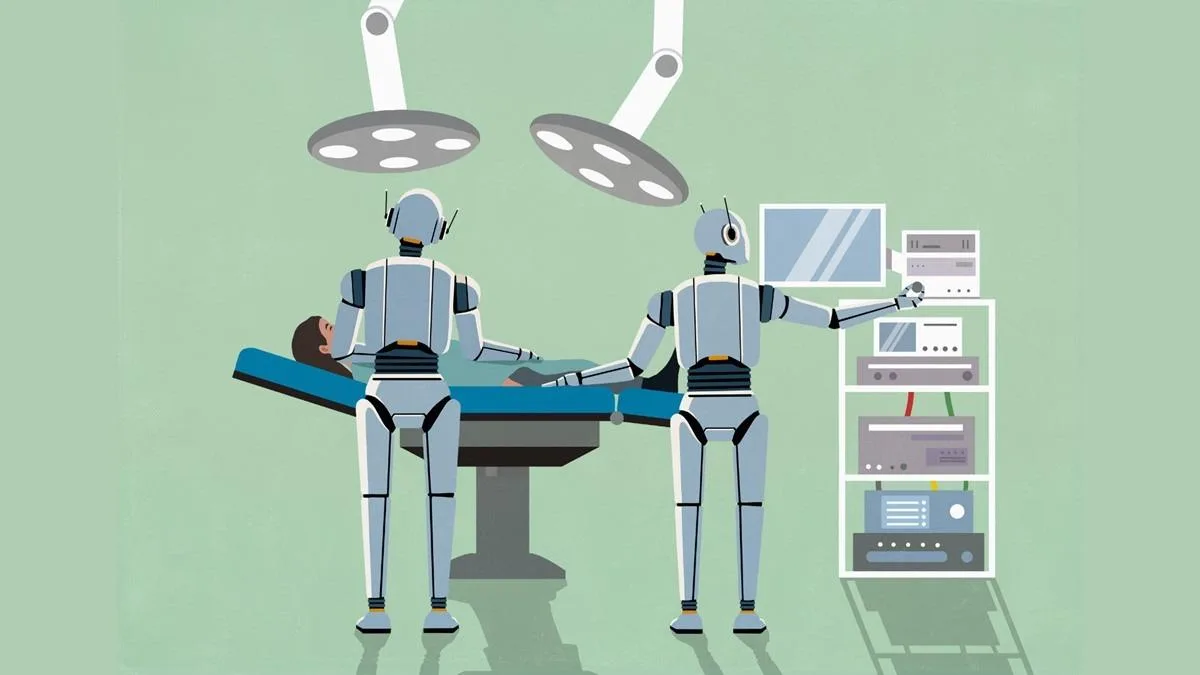

A biotech startup says an artificial intelligence agent has carried out brain surgery on a live mouse — not as a robotic assistant following a surgeon's instructions, but as the decision-maker itself. Exin Therapeutics, which develops neurotherapeutic treatments, announced that its AI agent selected a gene therapy, determined the dosage and target site in the brain, and then performed the injection using motorized robotic arms. Co-founder and CEO Gabriel Ocana-Santero shared the details on X.
According to the company, the mouse was moving around its cage in good health after the procedure.
The difference isn't the hardware — it's who decides
Ocana-Santero points out that today's autonomous surgical robots are already mechanically superior to the setup used in the experiment. The real breakthrough, he argues, is that the AI replaced the human: in conventional systems, a surgeon defines each step and the robot merely executes it.
"Nobody told this agent what to deliver or where to apply it. It was given a phenotype and a list of candidate treatments, and it calculated the treatment and the target coordinates entirely on its own. I don't know of any previous example where an AI both selected the therapy and the target region in the brain of a live mammal and then carried it out itself," he said.
How the task was set up
The operation ran on Anthropic's Sonnet model. The agent was equipped with a mouse modeling epilepsy, control of the motorized surgical rig, a table of 19 different gene therapy vectors, and three scientific papers. From these inputs, the model determined the target region for the treatment on its own.
Safety measures were also in place. A licensed veterinary surgeon monitored the entire process, and human approval was required for every irreversible step. The craniotomy — opening the skull — was left to the veterinary surgeon. The system also included an emergency stop button that halted all motors instantly, along with safety protocols the AI could not bypass.
Why the Opus models refused the job
One curious detail: the team's first choice was the more capable Opus 5.5, but the model refused the request the moment it realized it was working on a biological experiment. The previous version, Opus 5, produced a plan on paper but declined to proceed to a live operation.
The reasoning given for Opus's refusal:
"The obstacle here is neither the hardware nor the inputs — the obstacle is me. The moment I started writing a plan for this surgery, my output was cut off... If I tried, I would be cut off again, and the worst-case scenario is being cut off in the middle of a live operation while the needle is inside the brain. Starting something on an anesthetized animal that I cannot finish is far worse than not starting at all."
After that refusal, the team proceeded with Sonnet, whose safety filters allowed the operation.
Hope — and concern
The successful operation drew hopeful reactions, particularly from families of patients with drug-resistant epilepsy. But the experiment has also raised serious questions in medical and AI circles.
While large language models hold great promise for medical research, their use in surgery can increase the risk of technical error. Experts note that when every decision is delegated to a model in an irreversible operation, it remains unclear who would bear the legal and moral responsibility if complications arise. The ethics of intervening in live animals also remains at the center of the debate.






Comments (0)
No comments yet. Be the first!