

Ever stared at the string of A's, C's, G's and T's on a genetic test report and wondered what it all actually means? Hugging Face is addressing exactly that curiosity with Carbon-X, a model released as open source: genetic code now sits inside a chat interface, answering your questions in natural language.
The experience resembles using ChatGPT. You paste a sequence into a text box and ask what it does. No programming knowledge required — you simply type into a web demo accessible from your browser.
Not a lab device — you need a sequence first
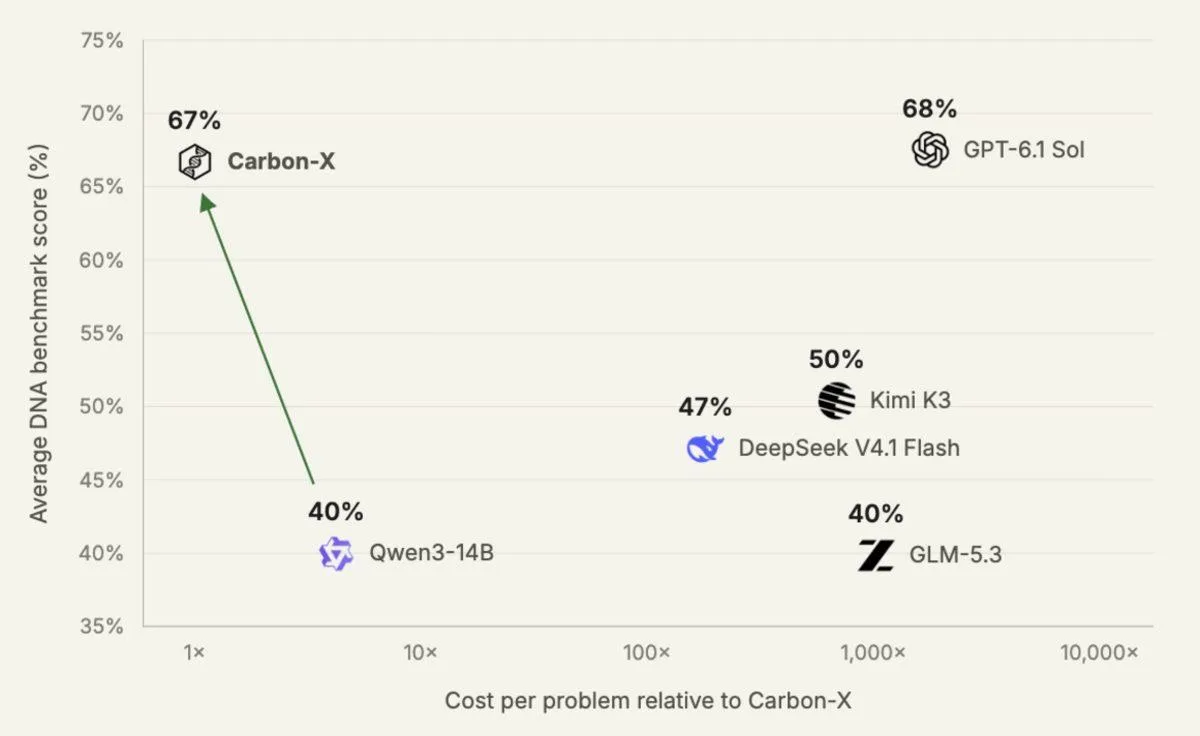
It's worth drawing the model's boundaries early. Carbon-X is not a device that reads your blood or saliva sample; it cannot turn a physical specimen into a digital sequence. If you want to bring your own data into the chat, you first need to take a genetic test and obtain your sequence.
There's a capacity limit, too. The human genome consists of roughly 6 billion letters, and the model can't take in that much at once. The input limit is up to 50,000 base pairs — meaning the conversation is about a segment containing the gene or mutation you're interested in, not the entire genome.
It analyzes — and it generates
Carbon-X treats DNA sequences the way a language model approaches text. Trained on approximately 300 billion data pieces, the system can examine sequences and predict the likely effects of mutations.
And it isn't limited to reading: it can also design entirely new DNA sequences from scratch. Researchers can therefore both analyze existing code and produce new code with a single tool.
Freedom from the cloud
For those who want to go beyond the web demo after trying it, there's another option: the model is light enough to run on your laptop even without an internet connection.
The speed comes from its reading method. Rather than processing letters one by one, it handles them in groups of six.
This local mode of operation has a privacy bonus: sensitive genetic data can be researched without being sent to cloud servers. Still, one distinction deserves emphasis — running the browser demo and running it on your own device are not the same experience.
Don't treat it as a diagnostic tool

Getting answers doesn't mean you can make health decisions based on them. Carbon-X is not clinically validated and is not suitable for diagnosis or personal health choices.
The risk familiar from chat-based AI persists here, too: with incomplete or ambiguous inputs, the model can produce fabricated answers — a phenomenon known as "hallucination." A fluent sentence is not proof that the information is correct.
In short: talking about genetic code is one thing; drawing a diagnosis from that conversation is quite another. With Carbon-X, that distinction needs to be kept firmly in mind.





Comments (0)
No comments yet. Be the first!