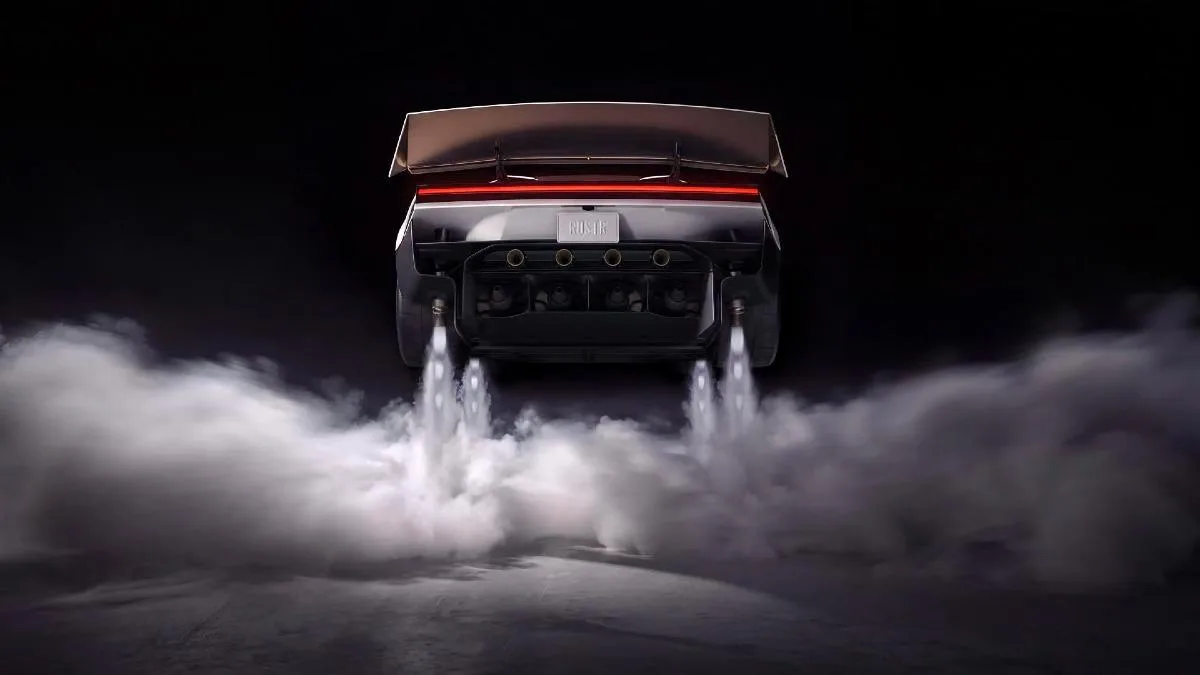

At Tesla's launch event in the United States, the long-awaited Roadster supercar finally took the stage — and then, astonishingly, it took to the air. During the presentation, the car lifted off in a scene straight out of a movie, leaving the audience stunned.
The demo showed the vehicle clearing a reverse ramp, performing a flip while airborne and landing smoothly. Which raises the obvious question: how did engineers manage to make a sports car fly?
Gases doing the heavy lifting
Footage shared from the event shows the car rising on jets of gas expelled from beneath it. That's where the secret lies: the Roadster was designed jointly with SpaceX, bringing components from the rocket world into the car. The cold gas thrusters installed on board enable the liftoff, mid-air maneuvers and a controlled landing.
In broad strokes, the car carries an aerospace-grade storage architecture. On board are ultra-high-pressure tanks with a combined 600-liter capacity, holding roughly 250 kilograms of compressed air. That air is released through 10 dedicated nozzles, giving the car the ability to glide and change direction in the air. Even more intriguing, the tanks can refill themselves — no chemical propellant required.
COPV at the core, Optimus in control
The backbone of the whole setup is a tank wrapped in carbon fiber, known as a "Composite Overwrapped Pressure Vessel" (COPV), capable of safely holding a huge volume of compressed air. Durable flanges at the ends are joined by 12 large bolts, and the structure connects directly to a main pipeline wrapped with two piston-like actuators.
The actuator motors come with a surprise of their own: these components were inherited from the ankle mechanism of Tesla's humanoid robot, Optimus. Their job is to precisely control the valves that release gas from the COPV at extremely high speed. The gas flows through two split, long lines to four cold gas thruster nozzles. That quartet is responsible solely for acceleration, while the total nozzle count — including other maneuvers and the soft landing — reaches 10.
Millimeter-perfect plumbing and exotic alloys
According to Lars Moravy, Tesla's Vice President of Vehicle Engineering, all the pipes running from the COPV's valves must be millimeter-identical in length, much like the equal-length pipe approach in exhaust manifolds. Even a tiny deviation in length can create uneven gas flow paths, meaning an imbalanced distribution to the nozzles. In a forward-thrust scenario, such a fault could cause the car to veer unintentionally.
The extreme pressure conditions and the need to keep weight as low as possible also shaped the material choices. The long lines and thruster nozzles are made of titanium, while the splitter fittings where the pipes divide to each side use Inconel, an alloy that withstands high heat and pressure.
Performance in numbers
Mass is roughly 1,700 kg, and the 0-100 km/h sprint is measured at 0.81 seconds. For that explosive launch, the cold gas thrusters need to add a net 19.8 kN of thrust to the system. Because figures such as the geometry of the CGT nozzle throats, the drag coefficient and the frontal area haven't been shared yet, it's impossible to calculate exactly how long that thrust can be sustained. Even so, estimates suggest that after a few seconds of rocket thrust, with the electric motors continuing to accelerate the car, it could reach at least the 220-290 km/h range in a very short time.




Comments (0)
No comments yet. Be the first!