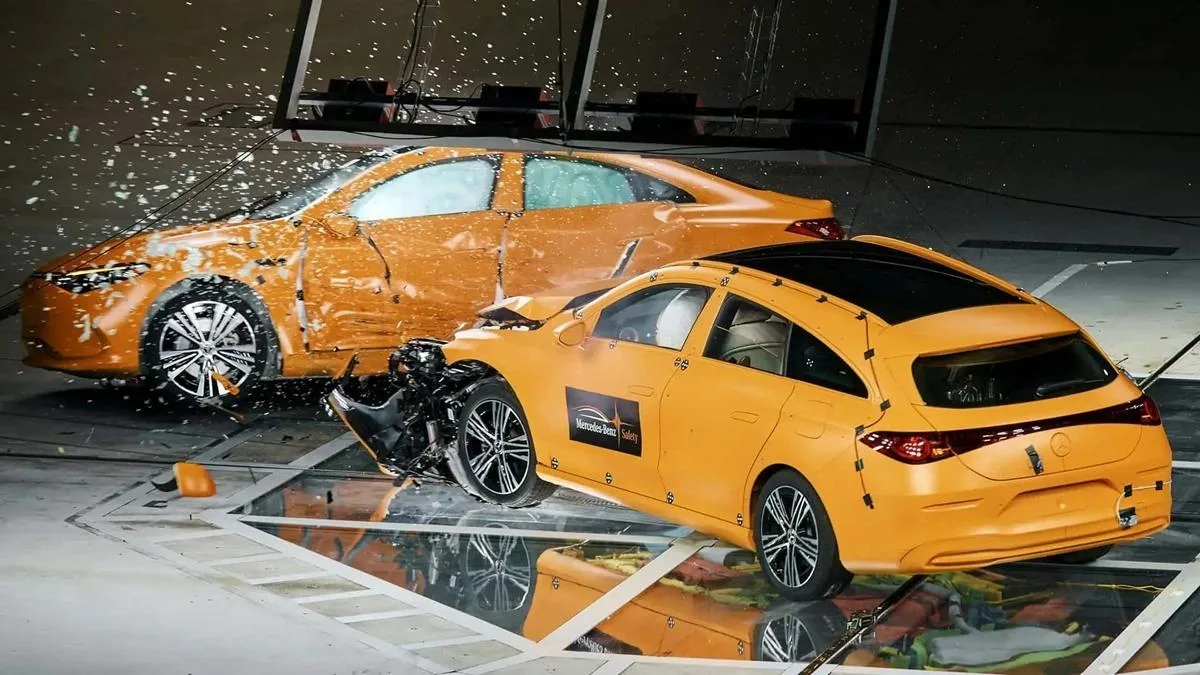

Crash testing usually means hurling a car at a fixed barrier or a movable block. Mercedes-Benz just threw out that playbook: it took two production CLAs off the line and drove them into each other, without a single touch of the brakes.
The German brand's goal was to recreate, as faithfully as possible, the kind of deadly intersection collisions that happen on public roads. The 56 km/h impact — a head-on and side collision combined — is being described as the first high-speed side-impact test ever conducted with real vehicles for public roads.
A real-world intersection scenario, tested with real cars
In the test, a hybrid CLA Shooting Brake weighing roughly two tonnes collided at a right angle with the fully electric CLA, mimicking a typical intersection crash. The 56 km/h speed sits among the highest impact speeds seen in real-world intersection accidents.
After the collision, the structural integrity of the passenger compartment held up in both vehicles. That rigidity prevented the cabin from being crushed — the test's single most critical safety objective.
Paul Dick, the company's Director of Vehicle Safety, said the approach stems from Mercedes-Benz's "Real Life Safety" philosophy, built on the study of more than 6,000 real accidents since 1969.
Eight dummies, safe results
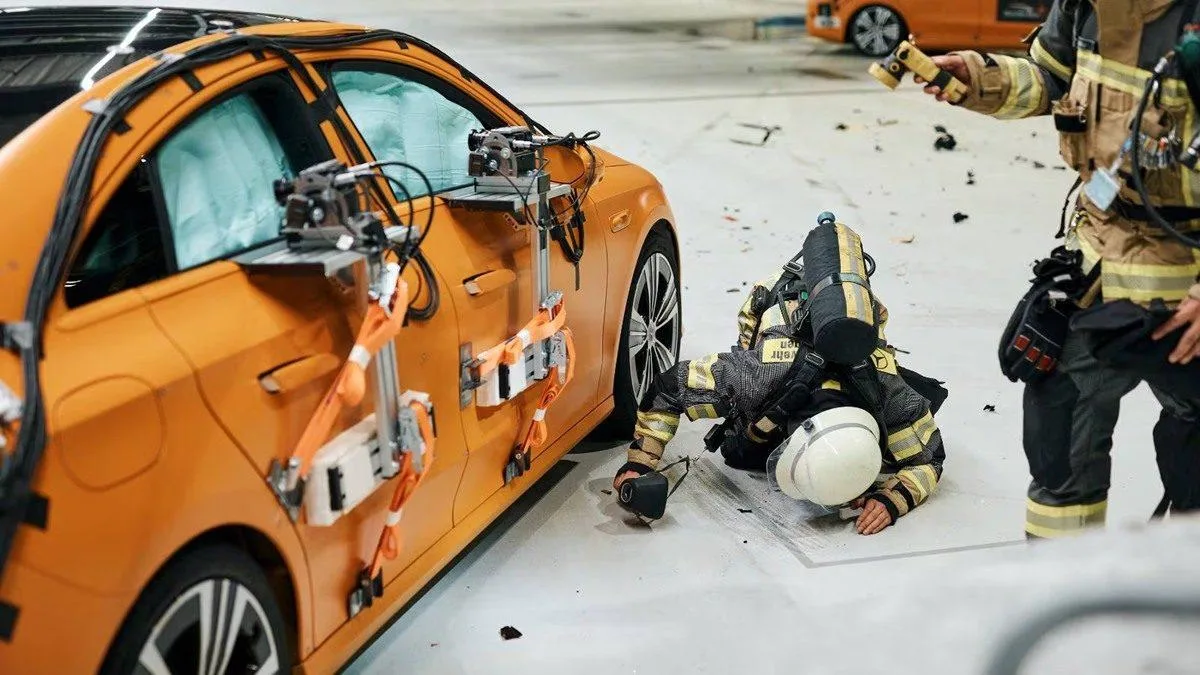
Data from the eight crash test dummies on board — four adult-sized and four child-sized — stayed below all biomechanical limits. In other words, no scenario of fatal or serious injury emerged.
The most closely watched element, however, was the battery pack in the floor of the electric CLA, which took the direct hit. According to Mercedes-Benz, the high-voltage battery retained its structural integrity, no cells were penetrated, and the system shut down automatically at the moment of impact — eliminating any risk of fire or electric shock.

Comments (0)
No comments yet. Be the first!