

Imagine sending the aroma of your morning coffee or a freshly baked cake to someone thousands of miles away. Researchers at Ohio State University and Zhejiang Laboratory have developed a system called Scentronic that converts smells into digital data and transmits them over the internet.
So how exactly does sending a scent online work? The logic behind the system is similar to sharing a photo.
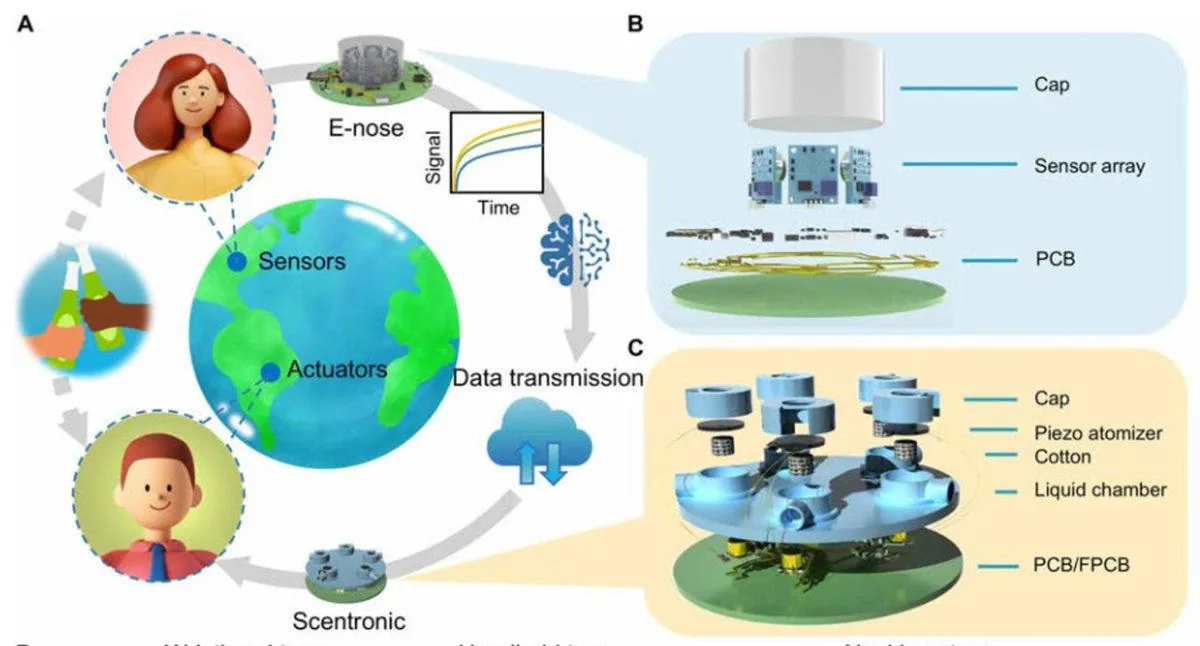
What travels is not the smell itself, but its digital recipe
Both parties need a device for the system to work: a sensing unit on the sender's side and a reproduction device on the receiver's end.
The sender's device analyzes the ambient scent with an AI-powered electronic nose and converts it into a digital code. What travels across the internet is this code, not the scent molecules. Much like the pixels of a photo, what is sent is a kind of recipe describing how the smell should be recreated. Thanks to Wi-Fi and cloud infrastructure, this recipe reaches the other side in less than a second.
Once the receiving device decodes the code, it selects the right one from among pre-installed scent cartridges. Special liquids in the cartridges come into play, and the scent is sprayed into the environment as micro-droplets.
A compact design worn on the neck or wrist
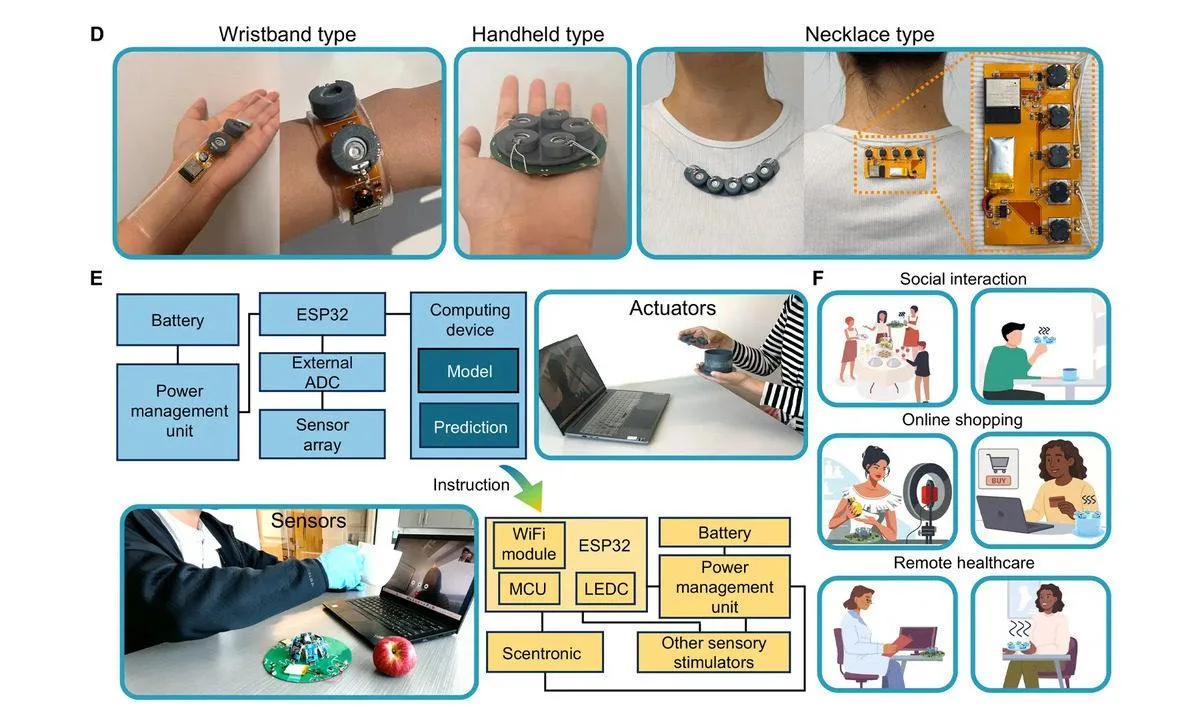
Earlier-generation systems of this kind relied on bulky desktop boxes or cumbersome helmets. Scentronic, by contrast, is small and sleek enough to be worn around the neck or on the wrist.
The device also has no overheating problem; instead of heating the liquid, it sprays it using micro-vibrations. Because it does not heat up even after hours of use, it poses no risk of skin burns.
More accurate than humans in tests
In laboratory tests, the system's electronic nose distinguished the smells of coffee, cake, orange, beer and red wine with almost 100 percent accuracy. Although coffee produced the weakest electrical signal from the sensors, the AI analyzed that signal and identified coffee without error. Volunteers asked to recognize the same smells managed only 73 percent accuracy.
Taste joins the smell: the Digital Cup
The researchers did not stop at smell; they integrated taste as well, producing a product called the "Digital Cup". When you put on a virtual reality headset and pick up a virtual coffee cup, the system activates automatically. Coffee aroma wafts to your nose from the cup's lid, while a mechanism in its body pumps coffee flavor into the liquid inside. That way, when you take a sip, you realistically experience both the smell and the taste of the virtual coffee.
At-home smell testing
Another important use for Scentronic is remote healthcare. As seen with COVID-19, patients who have lost their sense of smell (anosmia/hyposmia) or have heightened smell sensitivity (hyperosmia) can be tested at home without going to a hospital.
Through the cloud infrastructure, a physician can adjust the scent type and spray intensity in real time, monitoring the patient's detection thresholds on the fly to deliver personalized digital therapy and smell rehabilitation.





Comments (0)
No comments yet. Be the first!