

As a violent storm raged off the coast of Spain, French photographer Florian Riou captured a striking shot above a settlement on the island of Corsica. The photo quickly went viral on social media worldwide.
Some users saw the red beam of light as an alien invasion, others as an aurora. In fact, the phenomenon known in science as a "Red Sprite" is the product of an extremely powerful electrical discharge in the upper atmosphere. Neither an artificial experiment nor a mysterious entity.
What is a red sprite?
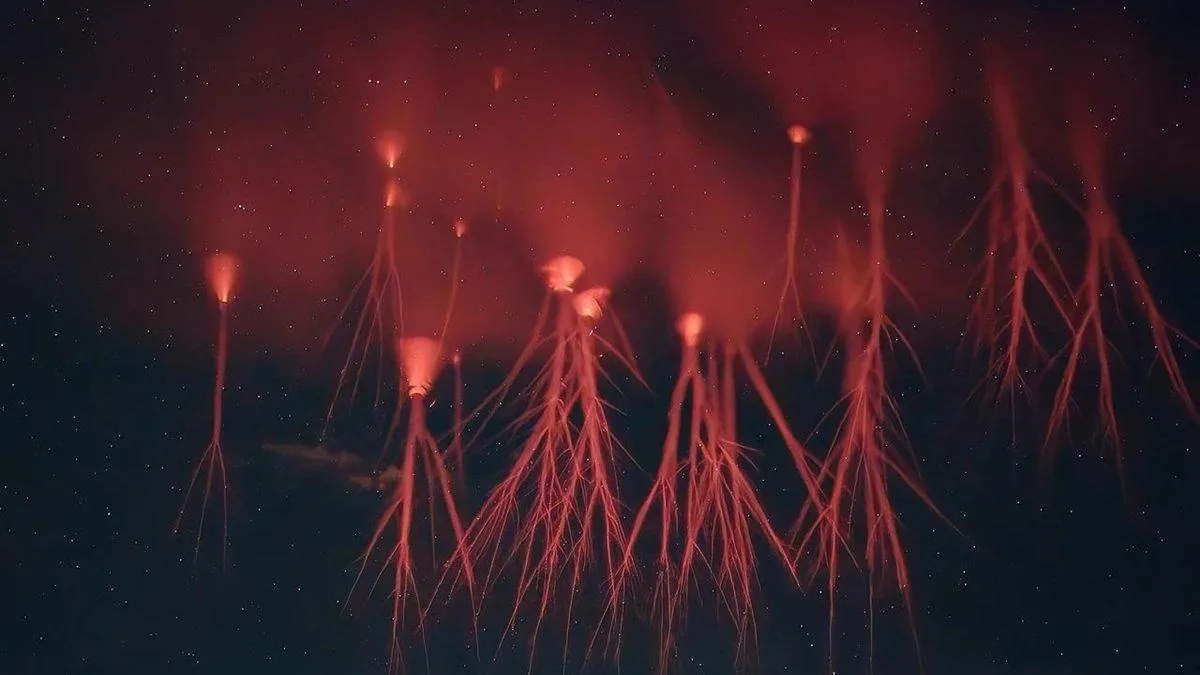
Red sprites are high-altitude electrical discharges that occur far above thunderstorms, at roughly 50 to 90 kilometers above the ground, in the mesosphere. In the scientific literature, they are classified under "Transient Luminous Events."
Unlike lightning, they don't occur between the ground and clouds or within clouds; they develop as an upward burst from the very top of the storm cloud toward the edge of space. With their glowing bodies and tentacle-like extensions tapering downward, they resemble a giant space jellyfish.
How does the formation mechanism work?
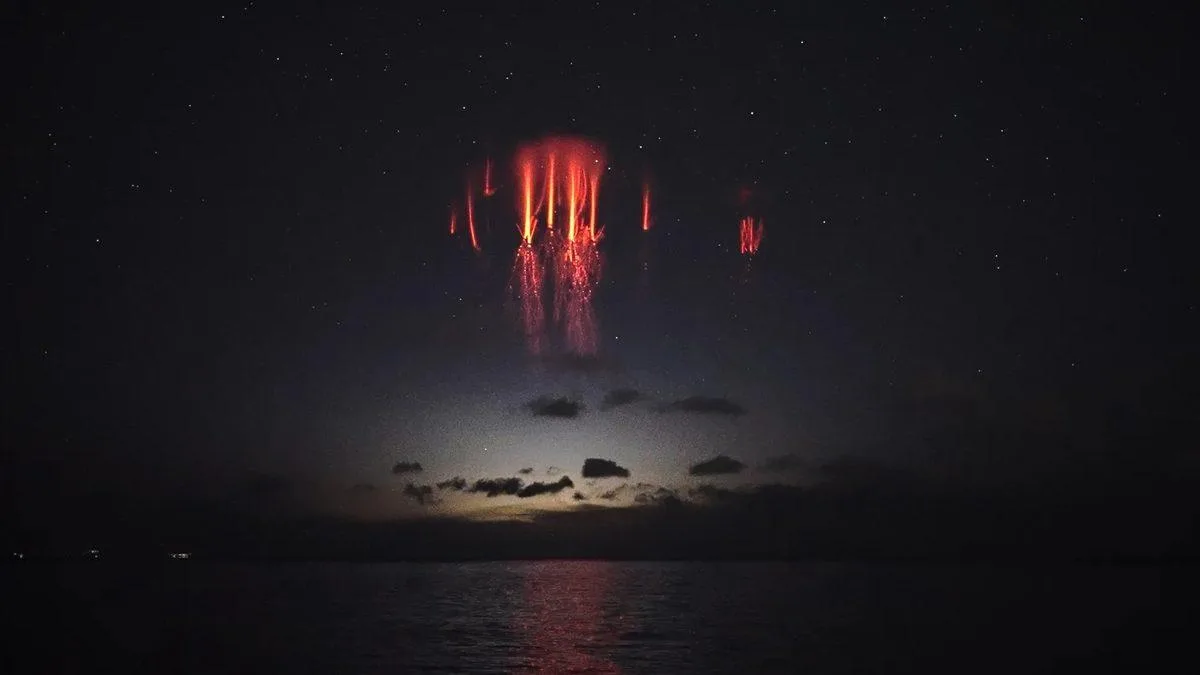
What triggers the event is not an ordinary lightning bolt. It requires an extraordinarily powerful, positively charged discharge descending from the cloud base to the ground. This discharge suddenly disrupts the electrical balance between the cloud top and the ionosphere, creating a massive voltage field in the upper atmosphere.
The air in the mesosphere is very thin. As the electrostatic field passes through this sparse layer of gas, it collides with and excites nitrogen molecules. Returning to their ground energy state, the nitrogen molecules emit photons; this glow appears to our eyes in vivid red and orange tones. The thin branches extending downward shift toward purple and blue as they reach denser layers of air.
Why is it so rare?
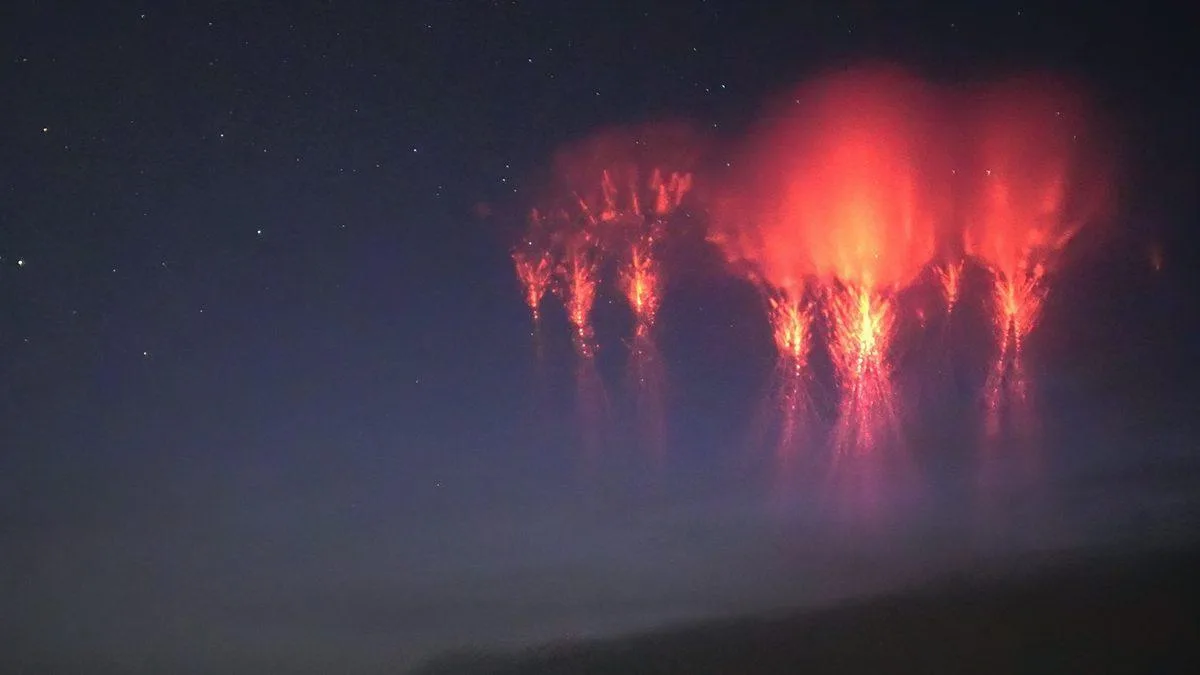
Red sprites remained a legend told only by pilots for years; scientific confirmation first came by chance on camera in 1989. The main reason for the late discovery is their short lifespan: a red sprite glows for only 5 to 300 milliseconds. The human eye mostly can't perceive these instant flashes, or dismisses them as a slight optical illusion.
Moreover, someone beneath or inside the storm can never see the event; thick storm clouds completely block the view of the upper atmosphere. To witness it, you need to stand at least 100 to 300 kilometers from the storm's core, have a clear horizon, and a night sky free of light pollution. In other words, these shots aren't luck; they're the result of meticulous planning by astrophotographers who track weather radars and use low-light sensors.




Comments (0)
No comments yet. Be the first!